

Buyer guide · updated July 2026 · by Waldenhaus
Quick answer: should you choose a polytunnel or a polycarbonate greenhouse?
Choose a film polytunnel if you want the largest growing area for the lowest upfront spend and you are comfortable replacing the cover every few years. Choose a polycarbonate tunnel greenhouse if you want the arched footprint of a tunnel but with rigid twin-wall panels, a steadier growing climate and less cover maintenance. Choose a timber polycarbonate greenhouse if the structure has to sit visibly in the garden, not just work hard at the end of the plot.
Film polytunnel
Best when the brief is simple: maximum covered growing space for seasonal crops, with the cover replacement treated as part of ownership.
Polycarbonate tunnel greenhouse
Best when you like the long arched layout but want screw-fixed twin-wall panels, better heat retention and a structure that feels more permanent.
Timber polycarbonate greenhouse
Best when appearance matters as much as crop space: a front-facing garden, kitchen garden, courtyard or home plot where the greenhouse is always in view.
Search terms such as polycarbonate polytunnel, polycarbonate tunnel greenhouse and polycarbonate greenhouse or polytunnel usually point to the same buying question: can you get the working footprint of a polytunnel without living with tensioned film? The useful answer is not a slogan. It is a trade-off between cost, warmth, wind exposure, maintenance and where the structure will sit.
One-minute comparison
Film polytunnel strongest here.
Rigid twin-wall polycarbonate strongest here.
Timber or well-framed polycarbonate greenhouse strongest here.
Twin-wall polycarbonate holds warmth longer than single-skin film.
Decision tree: answer these five questions
If yes, start with a film polytunnel unless site rules say otherwise.
If yes, compare timber or a cleaner rigid-panel structure, not just raw growing area.
If yes, check anchoring, frame section and panel fixing before comparing price.
If yes, twin-wall polycarbonate and reliable ventilation matter more than footprint alone.
If no, move away from film and compare rigid polycarbonate options.
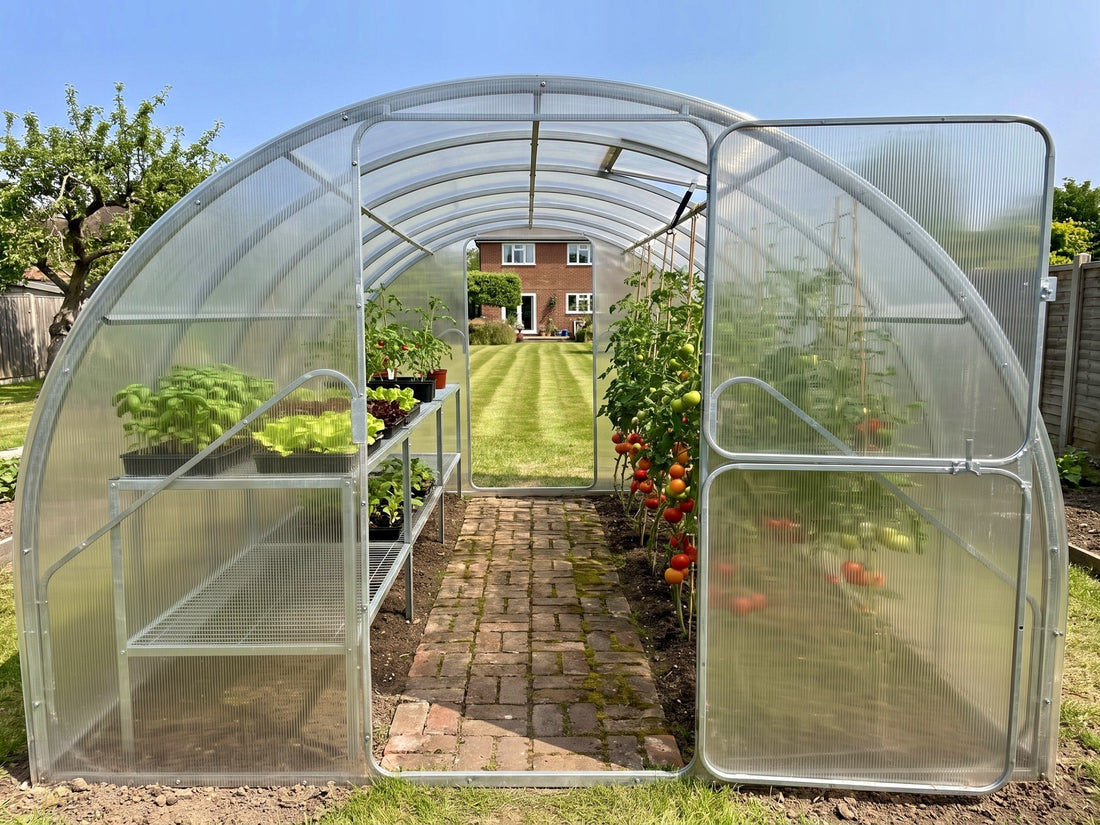
Answered “no” to question five? Then what you want is the tunnel footprint without the film — a rigid arch with panels that are screwed on and stay on. That is the SteelRoot route. The narrow-arch entry point is the Plot 3.14: a galvanised steel arch 3.00 m wide on the ground and 3.14 m at its widest, in five lengths from 4 m to 12 m.
What is a polycarbonate polytunnel?


Strictly, a polytunnel uses tensioned polythene film over hoops. Once the cover becomes rigid twin-wall polycarbonate, it behaves more like a greenhouse than a tunnel. That is why the clearer term is polycarbonate tunnel greenhouse: an arched frame, usually steel, clad with cellular polycarbonate panels rather than film.
The wording matters because it changes ownership. Film is stretched, tensioned and eventually replaced. Twin-wall polycarbonate is fixed panel by panel. Film usually wins on upfront cost and raw footprint. Polycarbonate wins when the buyer values permanence, warmth, a tidier appearance and less re-covering work.
The full comparison
| Decision point | Film polytunnel | Polycarbonate tunnel greenhouse | Timber polycarbonate greenhouse |
|---|---|---|---|
| Best use case | Seasonal growing, allotments, smallholdings, maximum covered area. | Long arched growing space with a more permanent rigid-panel build. | Home gardens where the greenhouse has to look settled and considered. |
| Upfront cost | Usually lowest per square metre. | Higher than film, lower than many heritage-style glasshouses. | Higher than a tunnel; you are also paying for the garden-building role. |
| Cover material | Single-skin polythene film. | 4 or 6 mm twin-wall cellular polycarbonate, depending on product/spec. | 4 or 6 mm twin-wall cellular polycarbonate on Waldenhaus NORDIC. |
| Cover replacement | Expected ownership task; replacement interval depends on film quality, UV exposure and site. | No film replacement cycle; individual panels can be replaced if damaged. | No film replacement cycle; individual panels can be replaced if damaged. |
| Heat retention | Good solar gain by day, quicker heat loss after sunset. | Twin-wall air gap holds warmth better than single-skin film. | Twin-wall air gap plus a more garden-room style structure. |
| Wind-exposed sites | Depends heavily on film tension, anchoring and how exposed the site is. | Look for screw-fixed panels, arch spacing, frame section and proper anchoring. | Look for screw-fixed panels, frame joints and anchoring; avoid spring-clip assumptions. |
| Appearance | Functional growing infrastructure. | More architectural than a film tunnel; still practical and agricultural in feel. | Most settled in a visible home garden. |
| Who should avoid it | Buyers who dislike re-covering work, visible film ageing or allotment restrictions. | Buyers who simply need the lowest cost per square metre. | Buyers who only need hidden crop space and do not care how it looks. |
Cost over 10 years: the honest answer
A polytunnel often remains cheaper over 10 years. That is not a weakness in the argument; it is the main reason polytunnels exist. The buyer gets a lot of covered space quickly, accepts that the cover is a consumable part and keeps the structure working through re-covering.
A rigid polycarbonate greenhouse asks for a higher first spend. The reason to pay it is not that it always beats a tunnel on pure pounds per square metre. The reason is that it changes the ownership experience: no full film re-cover, less flapping, better heat retention from twin-wall panels, a cleaner visual presence and, in the right specification, a more reassuring structure for exposed plots.
Costs people forget to include
| Cost or job | Film polytunnel | Polycarbonate tunnel greenhouse | Why it matters |
|---|---|---|---|
| Anchoring | Sometimes included, sometimes upgraded separately. | Should be part of the specification. | A good cover or panel system still fails if the structure is not properly held down. |
| Ventilation | End doors are not always enough in summer. | Check rear/gable windows and auto-vent compatibility. | Overheating and stale damp air damage crops faster than many buyers expect. |
| Cover or panel repair | Film patching and eventual re-covering are normal ownership tasks. | Individual panels can be replaced if damaged. | The question is not only purchase price; it is how the structure behaves after the first bad season. |
| Access and layout | Long tunnel space is efficient but can become a narrow work corridor. | Wider steel arches can support beds plus a walkway, depending on width. | A structure you dislike working in becomes wasted growing space. |
| Visual impact | Often acceptable on a hidden plot, less settled in a visible garden. | Cleaner and more permanent; timber usually looks most settled. | Many buyers upgrade because the first structure works but looks temporary. |
10-year ownership timeline
Buy, site, level and anchor. This is where many failures are decided: ground prep and anchoring matter.
Learn the climate inside the structure: when it overheats, where condensation sits, and how much airflow crops need.
Film tunnels usually face a cover decision around this phase. Rigid polycarbonate owners inspect panels, fixings and vents.
The winner is the structure still being used. A low first price loses value if the space becomes inconvenient or looks wrong.
Practical rule
If you are testing grow-your-own for the first time, start with a polytunnel. If you have already outgrown temporary covers, lost panels, reached a cover replacement point or need the structure to sit in view of the house, move to polycarbonate.
Wind, fixing and exposed sites


For UK buyers, the important question is not only “greenhouse or polytunnel?”. It is “how is the cover attached, and how is the frame anchored?”.
A film polytunnel depends on correct tension and secure base anchoring. If one weak point opens, the cover can work loose quickly in winter weather. An entry-tier polycarbonate greenhouse can fail differently: panels held by spring clips can release when the frame flexes or the clips lose tension.
For a rigid-panel structure, look for four details before you compare prices:
- Screw-fixed panels, not loose glazing held only by clips.
- Frame section that resists twist, not just a light open profile.
- Arch or bay spacing that reduces long unsupported spans.
- Anchoring that is part of the specification, not an afterthought.
Site-risk checklist
Prioritise anchoring, frame section and shorter unsupported spans. Treat film tension as a maintenance task, not a one-time setup.
Read the tenancy rules before buying. Some sites restrict polytunnels, visible covers, height, colour or footprint.
Measure door swing, wheelbarrow access, water access and whether the structure blocks light from a neighbour's garden.
Appearance becomes part of the decision. A structure can be technically right and still feel wrong in the garden.
Keep the first decision simple. If the budget is limited, a tunnel can teach you the routine before you buy a permanent structure.
Prioritise twin-wall panels, cross-ventilation, shade control and a layout you will actually use in winter.
Warmth, condensation and ventilation


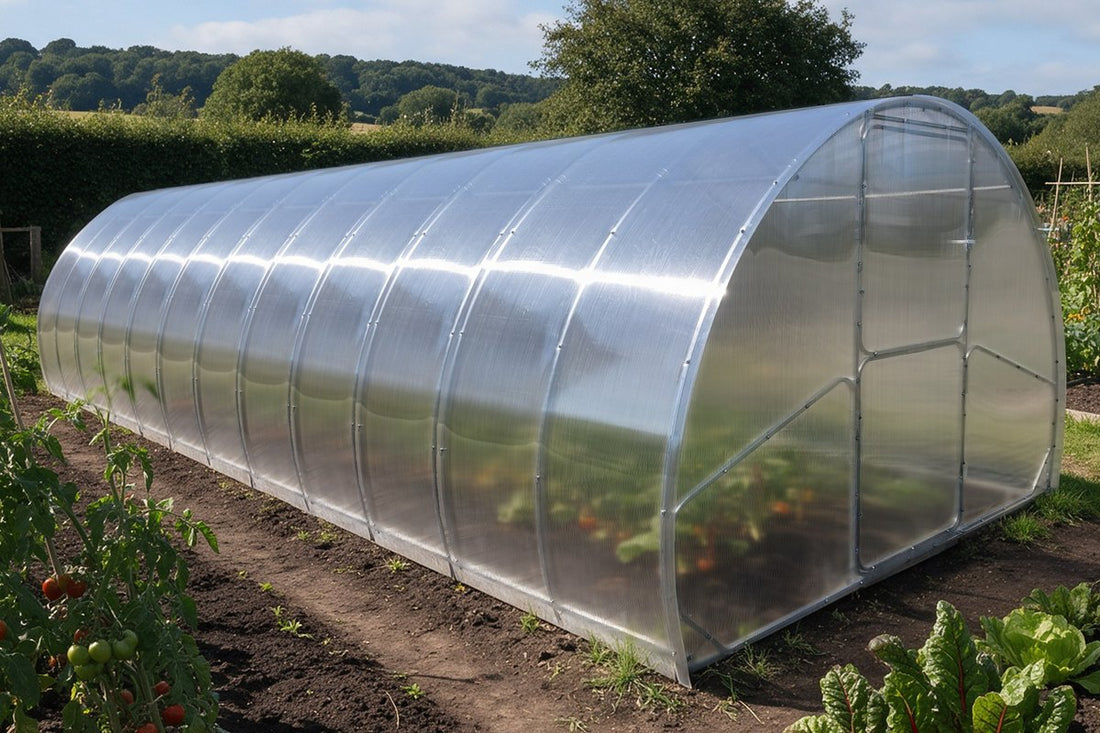
Film and twin-wall polycarbonate both bring in useful light. The difference is what happens after the sun drops. Single-skin film loses heat quickly. Twin-wall cellular polycarbonate has an air gap, so it holds warmth longer and makes early starts, late finishes and overwintering more realistic.
The trade-off is condensation. A warmer enclosed structure still needs air movement. Do not buy any greenhouse or tunnel on cladding alone; check door position, rear/gable windows, roof or side ventilation options and whether an auto-vent can be added later.
Waldenhaus NORDIC and SteelRoot both include cross-ventilation as standard: NORDIC has an opening door and a rear window opposite it; SteelRoot has a door at each end, and the top section of each opens on its own. SmartVent Auto-Vent Opener is an optional accessory, sold separately.
Allotments, visible gardens and planning reality
Allotment rules vary by site. Some sites are happy with polytunnels; others restrict size, height, colour or film structures because of visual impact and abandoned-cover problems. Check the tenancy agreement before buying any large covered structure.
In a private garden, the visual question matters more. A polytunnel reads as crop infrastructure. That may be perfect behind a hedge or in a working kitchen garden. If the structure is visible from the house, a polycarbonate tunnel greenhouse feels more permanent, and a timber-framed greenhouse usually feels most at home.
Planning note for England: Planning Portal lists greenhouses under outbuildings and says permitted development depends on conditions such as position, height, boundary distance, designated land and listed-building status. Check the Planning Portal outbuildings guidance and your local authority before ordering if the site is listed, designated, near a boundary or governed by allotment rules.
Which Waldenhaus route fits this decision?
SteelRoot
Choose SteelRoot if you want the tunnel-style footprint with a galvanised steel frame, 1.0 m or 0.67 m arch spacing, and 4 or 6 mm twin-wall polycarbonate. It is the more practical route for serious growing area, exposed plots and buyers who want the polycarbonate answer to a polytunnel.
NORDIC
Choose NORDIC if the greenhouse needs to become part of the garden, not just a growing tunnel. It uses an FSC-certified pine timber frame, galvanised steel at the joints and 4 or 6 mm twin-wall polycarbonate.
Check the cover
Film is a consumable cover. Twin-wall polycarbonate is a rigid panel system.
Check the fixing
Screw-fixed panels give a different ownership experience from spring clips or tensioned film.
Check the airflow
Warmth is useful only if the structure can vent properly in summer and on damp winter days.
Check the site
A sheltered garden, exposed plot and allotment tenancy can all lead to different answers.
Can you put polycarbonate sheets on a polytunnel frame?
Usually, this is the wrong retrofit. A film tunnel frame is designed to hold a tensioned skin. Rigid polycarbonate panels need fixing points, edge support, washered screws, allowances for expansion and a frame that can carry local loads panel by panel. If the existing hoops are light or widely spaced, adding rigid panels can create stress points rather than a stronger greenhouse.
If you already own a polytunnel and want to upgrade, ask three questions before buying sheets:
- Does the frame supplier approve rigid polycarbonate on that model?
- Are there continuous fixing rails or only hoops intended for film?
- Will the door, end walls and ventilation still work once the cover becomes rigid?
If the answer is unclear, it is usually cleaner to buy a purpose-built polycarbonate tunnel greenhouse rather than turn a film structure into a compromise.
Common buying mistakes
- Comparing only the first price. Add the cover replacement cycle, time to re-cover and whether anchors or vents are extra.
- Assuming every polycarbonate greenhouse is the same. Panel fixing, frame section and anchoring matter more than the word “polycarbonate”.
- Ignoring ventilation. A warm structure without enough airflow can overheat in summer and hold damp air in winter.
- Buying for May, not February. Ask whether you will still want to use the structure during wind, rain and short days.
- Skipping the site rules. Allotment and conservation-area rules can matter more than the product comparison.
Frequently asked questions
Is a polycarbonate tunnel greenhouse the same as a polytunnel?
No. A polytunnel uses tensioned polythene film. A polycarbonate tunnel greenhouse uses rigid twin-wall cellular polycarbonate panels on an arched frame. The shape can look similar, but the cover, warmth, maintenance and ownership experience are different.
What is a polycarbonate polytunnel?
It is usually a search phrase for an arched greenhouse with twin-wall polycarbonate panels. The more accurate term is polycarbonate tunnel greenhouse. It gives the long tunnel-style layout without a film cover replacement cycle.
Is a polytunnel better than a greenhouse?
A polytunnel is better for the lowest upfront cost per square metre. A greenhouse is better when permanence, appearance, heat retention, ventilation control and a visible garden setting matter more than the first price.
Which is warmer: a polytunnel or a polycarbonate greenhouse?
A twin-wall polycarbonate greenhouse usually holds warmth better than a single-skin film polytunnel because the cellular panel has an air gap. Both still need ventilation and shading in summer.
Do polycarbonate tunnel greenhouses need the cover replacing?
Not in the same way as film polytunnels. Individual panels can be replaced if damaged, but there is no whole-cover re-tensioning cycle like a polythene tunnel.
Which is better for a windy or exposed site?
Do not decide from the category name alone. Check frame section, panel fixing, bay or arch spacing and anchoring. A well-anchored rigid-panel structure with screw-fixed panels is usually the more reassuring route for an exposed site than a light film tunnel.
Should I choose SteelRoot or NORDIC?
Choose SteelRoot if the priority is serious growing area, an arched steel structure and a polycarbonate answer to a polytunnel. Choose NORDIC if the greenhouse will be a visible garden feature and timber appearance matters as much as crop space.
Can I replace polytunnel film with polycarbonate sheets?
Only if the frame is designed and approved for rigid sheets. Most film tunnel frames are not built with the fixing rails, edge support and ventilation changes that polycarbonate panels need.
Is a polycarbonate tunnel better than a glass greenhouse?
It depends on the job. Polycarbonate is lighter, safer around children and more forgiving on exposed plots. Glass looks clearer and more traditional, but it is heavier and can be more vulnerable to breakage. For a working growing tunnel, twin-wall polycarbonate is often the more practical material.
What should I check before buying any polytunnel alternative?
Check the cover material, how the cover is fixed, the frame section, ventilation, anchoring, replacement parts, site rules and whether the structure will still look right after five winters.
Next step
If you are comparing polytunnels because you want covered growing space, start with the greenhouse size calculator. If your decision is really about film versus rigid panels, compare SteelRoot. If the structure will sit in a visible garden, compare NORDIC.


