

Why placement matters more than you'd think
A greenhouse with bad placement still grows things, but you're working harder for less yield. The five things that change with placement:
- Light hours per day (can vary from 4h to 10h on the same garden depending on shade)
- Internal temperature on cold mornings (frost pockets sit 3-5°C colder than the rest of the garden)
- Wind exposure (a sheltered position protects the structure far better than an exposed one)
- Drainage (waterlogged ground transmits dampness to the timber frame and accelerates rot)
- Practical access (you're carrying compost, water, harvest baskets to and from it for 20 years)
Get all five right and you have a high-yield growing space. Get one wrong and you're compromising; two wrong and you'll regret the location within a year.

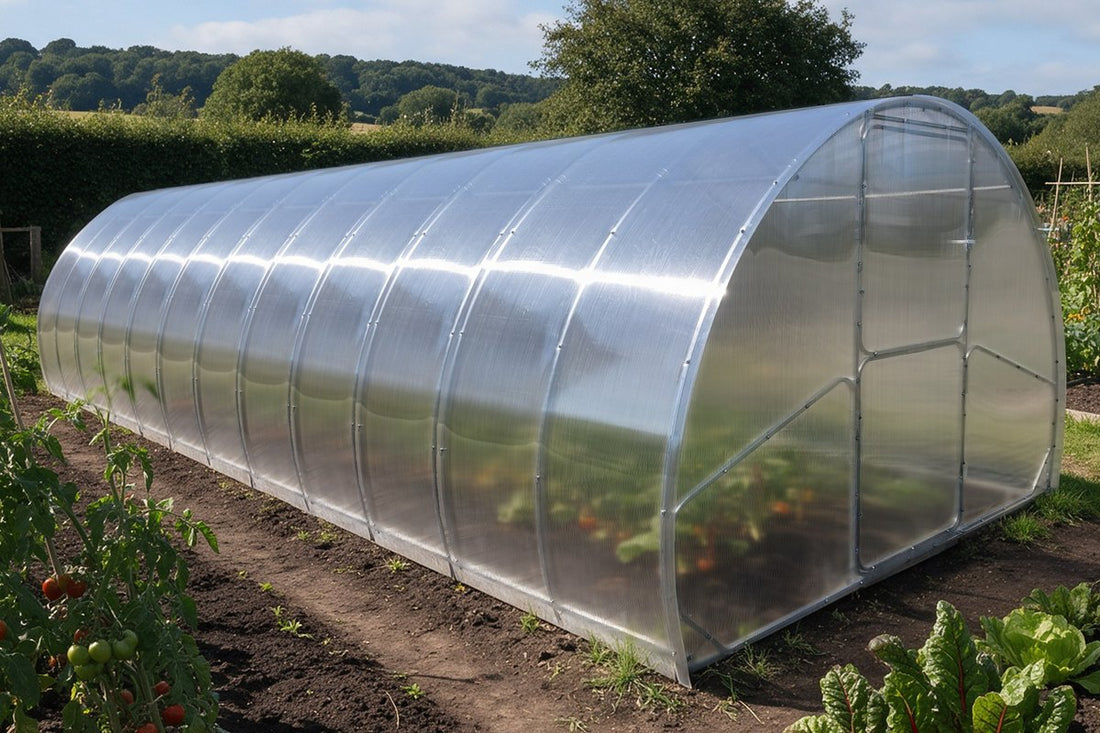
SteelRoot Plot 3.14 · steel arch greenhouse
Placing a SteelRoot Plot 3.14
The five decisions below hold for any greenhouse. Where this guide gives a figure for a timber greenhouse, the SteelRoot Plot 3.14 has its own, from its assembly manual and base plan.


- 2 m clear on every sideThe manual asks for 2 m clear of fences and buildings, with nothing overhanging. That is more than the 60–90 cm this guide gives for a timber greenhouse.
- The space to allowThe base is 3.2 m wide and your length plus 0.25 m. With 2 m around it, a 4 m greenhouse needs 7.2 × 8.25 m; add 2 m for each step up in length.
- No base on firm, level soilIt stands straight on the ground and the ground anchors in the kit hold it down. On loose, wet or sloping ground, build a base first.
- 2.02 m to the ridgeUnder the 2.5 m height limit that applies close to a boundary. The other planning limits depend on the nation and the property.
- An exposed plotChoose 0.67 m arches and 6 mm sheets: more arches and fixings along the length, a stiffer sheet over a shorter span. It is the strongest build we make.
- Getting it thereOne pallet, 1.2 × 0.8 m and about 2.3 m tall, set down at the kerb. From there the kit goes to the garden by hand, as bundles and sheets.
Decision 1: Sun, orientation and shade
The UK rule of thumb: the long axis of the greenhouse should run east-west. This means the long sides of the greenhouse face south and north. It maximises low-angle winter sun coming through the south wall.
Why east-west long axis:
- December UK sun rises at ~8am SE and sets at ~4pm SW, low in the sky (~15° elevation at midday)
- A long south-facing wall captures that low sun across the whole structure
- A long north-facing wall casts negligible shadow (sun never hits it directly)
- Glazing area exposed to sun = roughly the floor area of the greenhouse × 2-3 in the optimal orientation, vs less in suboptimal
If east-west isn't possible (long thin garden, fence orientation forces it): north-south long axis is workable but you'll lose ~20-30% of winter light. Plant heat-loving crops (tomatoes, cucumbers) on the SOUTH end of the structure. East-side growing benefits from morning sun, west-side from afternoon, both fine, but neither matches a true east-west long axis.
Avoid shade from:
- Tall trees within ~6m on the south side (dappled shade kills tomato yield)
- Fences over 1.8m within 2m on the south side
- House walls within 4m on the south or southwest (especially if they're 2-storey)
Mid-morning sun matters more than midday sun. A position that's shaded until 10am loses 2 hours of best growing light per day. Position so first direct sun hits the structure by 9am latest.

Decision 2: Frost pockets and microclimate
Frost pockets are low areas of the garden where cold air settles on still nights. They can sit 3-5°C colder than the surrounding garden, which means seedlings die in your "frost-protected" greenhouse on a March morning.
Identify a frost pocket in your garden:
- Walk the garden at 6am on a frosty morning (mid-March is good)
- Where is the frost still solid when the rest is melting? That's the pocket
- These are usually: depressions, areas behind solid walls/fences blocking air drainage, north-facing slopes
Don't put a greenhouse in a frost pocket. It'll cost you 3-4 weeks of growing season every year and you'll need supplementary heat to grow anything cold-tender.
Conversely, the best microclimate position:
- South-facing aspect (south-facing slope of even 1-2°)
- Slightly elevated (cold air drains away)
- Shielded from north and east winds (these are the cold ones)
- Near (not against) a south-facing wall: the wall acts as thermal mass, releasing heat overnight. Don't place the greenhouse hard against the wall (no air flow on the back panel = condensation, rot)
- 60-90 cm clear of any wall lets you maintain the back of the structure
Urban gardens often have artificial microclimates worth exploiting: a south-facing brick wall holds heat well; a paved courtyard reduces ground frost; a sheltered city-block garden can be 2-3°C warmer than a rural exposed one.
Decision 3: Wind exposure (UK storm survival)
UK storm season (October to March) brings sustained winds that test any garden structure. A greenhouse placed in a wind-tunnel position needs to be:
- Anchored more aggressively than a sheltered position
- Specced with screw-fixed glazing (not spring-clip)
- Possibly fitted with windbreaks
Identify the prevailing wind in your garden:
- The UK prevailing wind is south-westerly. But local geography matters more: a valley channels wind, a row of houses creates a wind shadow.
- Check on a windy day: where does the laundry blow? Where do leaves accumulate?
- The windward side gets the sustained pressure; the leeward side gets vortices that can be even more damaging in some cases.
Best wind position:
- Lee side of an existing windbreak (mature hedge, fence, wall, garage), but at least 3-4m clear of it (turbulence near solid obstacles)
- Behind (downwind of) a permeable windbreak (hedge, slatted fence): these slow wind without creating vortices
- NOT in the open at the top of a slope or in a wind-funnel between buildings
If the only viable position is wind-exposed:
- NORDIC's screw-fixed CrystalLight panels are built for this: mechanically retained, engineered for British storm conditions
- Add ground-screw anchoring (deeper than corner brackets alone)
- Consider planting/installing a permeable windbreak 2-4m upwind
→ Deeper read: Wind-Resistant Greenhouse UK: How to Choose for Storm Season
Decision 4: Drainage and ground conditions


Waterlogged ground is the slow-burn killer for wooden greenhouses. The base sills sit on damp earth, soak up moisture from below, and rot from the bottom up over 5-8 years even with surface re-treatment.
Check your prospective spot:
- After heavy rain, does water pool here for >24 hours? Bad sign.
- Dig a 30cm test hole. If it fills with water from below within 1 hour, you have high water table.
- Areas at the bottom of slopes accumulate runoff, also bad.
Best drainage positions:
- Slight elevation (even 5-10cm above surrounding ground helps)
- South-facing slope of 1-3° (good drainage + good sun = same axis often)
- Sandy or loamy soil rather than clay
- Above the water table by at least 1m
If your only viable spot is wet:
- Build up the base by 10-15cm with hardcore + paving slabs (raises greenhouse above water table)
- Install perimeter drainage (French drain or perforated pipe in gravel) before laying the base
- Don't try to drain the entire garden, drain just the greenhouse footprint
→ Deeper read: Greenhouse Base Preparation UK: what your foundation really costs → Related: What Makes a Greenhouse Last 30 Years (drainage is one of the four durability variables)

Decision 5: Practical access
Often forgotten, this is the position decider that affects daily use for 20 years.
Access from house:
- Distance to the kitchen door, you'll be walking with seed trays, harvest baskets, watering cans for two decades
- Path quality between house and greenhouse, paved or gravel beats lawn (which gets muddy in winter)
- Lighting, can you reach it on a December evening without tripping?
Access for utilities:
- Water: within hose reach of an outdoor tap, OR plan rainwater collection at the greenhouse (gutters into a butt). Hauling watering cans 20m × 5 trips = your weekend.
- Power: if you'll heat in winter, an outdoor-rated socket within ~10m via underground armoured cable. Rough cost £200-£400 for a sparky to install.
- Compost / waste: path to your compost heap should be wheelbarrow-passable.
Access for delivery + assembly day:
- 95-230 kg pallet needs to get from kerb to install spot. A 1.5m side gate that's the only access to a back garden = 4-hour shuffle with sack barrows or you're trying to lift palletised flat-pack over a 2m fence.
- Measure the narrowest point on the route. If under 90cm, the pallet won't fit. Check before ordering.
Access for future maintenance:
- 60-90cm clear perimeter all around lets you clean panels, re-treat the timber every 2-3 years, replace a panel after impact
- Hard against a fence = you can never re-treat the back panel = rot in year 5
Permitted Development implications
A reminder of the placement constraints under UK Permitted Development:
- NOT in the front garden (between house and road), always needs planning permission
- Within 2m of any boundary, the total height of the building (measured to the ridge, not the eaves) cannot exceed 2.50m (NORDIC's 2.30m ridge height comfortably clears this)
- Total outbuildings ≤ 50% of garden area including all sheds + summerhouse + greenhouse combined
- Conservation Area / Listed Building: planning permission required regardless
→ Deeper read: Greenhouse Permitted Development UK: when you need planning permission
Putting it together: the 5-decision worksheet
For each viable greenhouse position in your garden, score 1-5 (5 = best):
| Decision | Position A | Position B | Notes |
|---|---|---|---|
| Sun (east-west long axis, no shade until 10am, south-facing aspect) | _ | _ | |
| Microclimate (not in frost pocket, slightly elevated, sheltered from N/E winds) | _ | _ | |
| Wind (lee of windbreak 3-4m+, not in funnel, not exposed top of slope) | _ | _ | |
| Drainage (no water pooling, slope 1-3°, above water table by 1m+) | _ | _ | |
| Access (close to house, hose-reach water, 60cm+ perimeter, pallet route works) | _ | _ | |
| TOTAL | _/25 | _/25 |
A position scoring 20+ is excellent. 15-19 is workable. 10-14 means at least one constraint will need engineering (drainage, anchoring, supplementary heat). Below 10, find a different spot or reconsider.
Most UK gardens have one Position A and a fallback Position B, and the fallback usually loses 5-10 points across the matrix. The cost of "settling" for Position B over a 20-year structure is real but often invisible until year 3.
Frequently asked questions
Which way should a greenhouse face in the UK?
The long axis should run east-west, with the long sides facing south and north. This maximises low-angle winter sun through the south wall. If geometry forces north-south orientation, you'll lose ~20-30% of winter light but it's still workable.
How far from the house should I put a greenhouse?
Far enough for clear access (60-90cm minimum perimeter) but close enough for daily use (under 30m from the kitchen door is comfortable; under 10m is excellent). Don't put it directly against a house wall: that blocks the back-panel ventilation, accumulates condensation and accelerates rot. A south-facing wall 1-2m away is ideal: it provides thermal mass and windbreak without blocking maintenance access.
Can I put a greenhouse under a tree?
No, if you can avoid it. Even dappled shade from a deciduous tree kills tomato/cucumber yield through the summer. Falling leaves clog the gutters and the south-side glazing gets heavy moss. Persistent shade also accelerates the algae growth on polycarbonate panels (which then need spring cleaning twice as often). Aim for at least one greenhouse-length of clearance from any tall trees on the south side.
What's the best aspect: north-facing slope or south-facing slope?
South-facing slope every time. Even a 1-2° south-facing slope gives:
- Better cold-air drainage (no frost pocket)
- More direct sun in winter (when low-angle sun hits the slope at a more direct angle)
- Better drainage of rainwater
- North-facing slopes lose 2-3°C overnight, accumulate frost, drain more slowly.
Is it OK to put a greenhouse on grass?
No, bare lawn sinks under the weight (95-230kg + glazing). The structure shifts within 6-12 months, joints loosen, frame stress fractures appear in year 2-3. Always prepare a proper base (paving slabs on hardcore, concrete pad, or ground screws + perimeter timber). See Greenhouse Base Preparation UK for the materials and DIY process.
Should the greenhouse door face the house or away from it?
Personal preference, both work. Door-facing-house gives convenience (carry trays straight in/out). Door-facing-away gives more privacy when working inside. Whichever direction, position the door on the leeward side of the prevailing wind so wind doesn't slam it open or rip it off its hinges in a storm.
Can I put a greenhouse in a north-facing back garden?
Technically yes, practically with caveats. A north-facing garden (the garden side of the house faces north) means the greenhouse may have only 4-6 hours of direct winter sun even in the optimal spot. Crops will grow but seasons are compressed (later spring start, earlier autumn end). Compensate with: easternmost placement (catches morning sun), supplementary lighting in mid-winter, focus on shade-tolerant crops (lettuce, brassicas, leafy greens) over heat-loving (tomatoes, peppers).
How much clearance do I need around a greenhouse for maintenance?
60cm minimum on three sides; 90cm on the door side. Tight but workable for re-treatment with a brush + assembly. 90cm minimum all around is comfortable and lets you wheelbarrow alongside without scraping the panels. Less than 60cm and you can't fit a step-ladder for the roof, can't re-treat the back, can't replace a panel after impact, and that compromises both warranty and long-term durability.
Next steps
Once you've identified the position, plan the base preparation 2-4 weeks before delivery, the base needs to be settled and ready when the pallet arrives. See Greenhouse Base Preparation UK for the materials list.
For full pre-purchase research, the 9-step wooden greenhouse buying guide covers placement alongside size, glazing, frame, warranty, assembly, and storm planning, in priority order.
Browse the NORDIC range, five sizes from £999, when you're ready.


