

In short: aluminium is lighter, cheaper and never rots, so it suits a sheltered garden on a budget; a timber frame holds overnight warmth better, sits more solidly in wind and looks the part, for a higher price and a re-treatment schedule. Below, seven differences that decide which is right for you.
If you already know you want timber, start with the wooden greenhouse range guide. This comparison is for the material decision; the buying route lives on the hub and NORDIC PDP.
Updated April 2026
Written by the Waldenhaus team
If you're weighing up a wooden vs aluminium greenhouse, you've probably noticed the two camps rarely give you the full picture. Aluminium is light, cheap to buy and never rots. Timber holds a little more warmth, sits more naturally in a garden and, done right, stands up to British weather just as well. The trade-offs that actually matter only show up after a season or two of use.
This guide walks through the seven differences most buyers wish they'd known first: overnight warmth, condensation, real-world maintenance, behaviour in wind, noise, resale appeal, and the third frame option few people consider. Where it's relevant, we'll show how our NORDIC wooden greenhouses are engineered for British storm conditions, and where aluminium genuinely makes more sense.

Wooden vs Aluminium Greenhouse: the short answer
A wooden vs aluminium greenhouse choice usually comes down to three things: warmth in the shoulder seasons, how the structure copes in wind, and how it sits in your garden. A 45×45 mm timber frame holds a little more overnight heat than a thin aluminium extrusion and looks at home next to planting. Aluminium costs less up front and never rots. Neither is truly maintenance-free; they simply need different care.
For most British gardens we'd put it this way: choose aluminium if lowest upfront cost and self-build weight are the priority; choose a wooden greenhouse if you want a structure that buffers temperature swings, stays quieter in rain, and reads as a garden feature rather than a utility shed. Our NORDIC range answers that with 45×45 mm FSC Swedish pine, 4 mm CrystalLight twin-wall polycarbonate that's screw-fixed (not held by spring clips), and galvanised Ground Screw Anchors that fix without concrete. Five sizes run from 8x6 ft to 8x20 ft at £999 to £1,499.
The seven sections below explain the differences most buyers only discover after they've bought.
| Factor | Aluminium frame | Wooden frame (NORDIC) | Steel arch (SteelRoot) |
|---|---|---|---|
| Frame material | Thin aluminium extrusion | 45×45 mm FSC Swedish pine | Galvanised steel arch |
| Glazing | Typically 3 mm horticultural glass | 4 mm CrystalLight twin-wall polycarbonate (screw-fixed) | 6 mm twin-wall polycarbonate |
| Overnight warmth | Lowest: frame conducts heat out | Holds a little more heat in shoulder seasons | Good with thicker polycarbonate |
| Rot risk | None | Re-treat every 2 years to keep the anti-rot cover valid | None |
| Wind | Spring-clip glazing can dislodge | Engineered for British storm conditions; screw-fixed panels | Engineered for British storm conditions; arched profile |
| Look in the garden | Utility/functional | Garden feature | Modern, low-profile |
| Typical UK price | From ~£1,800 (quality alu) | £999 to £1,499 (five sizes) | From £899 |
1. Your Aluminium Frame Is a Giant Heat Sink
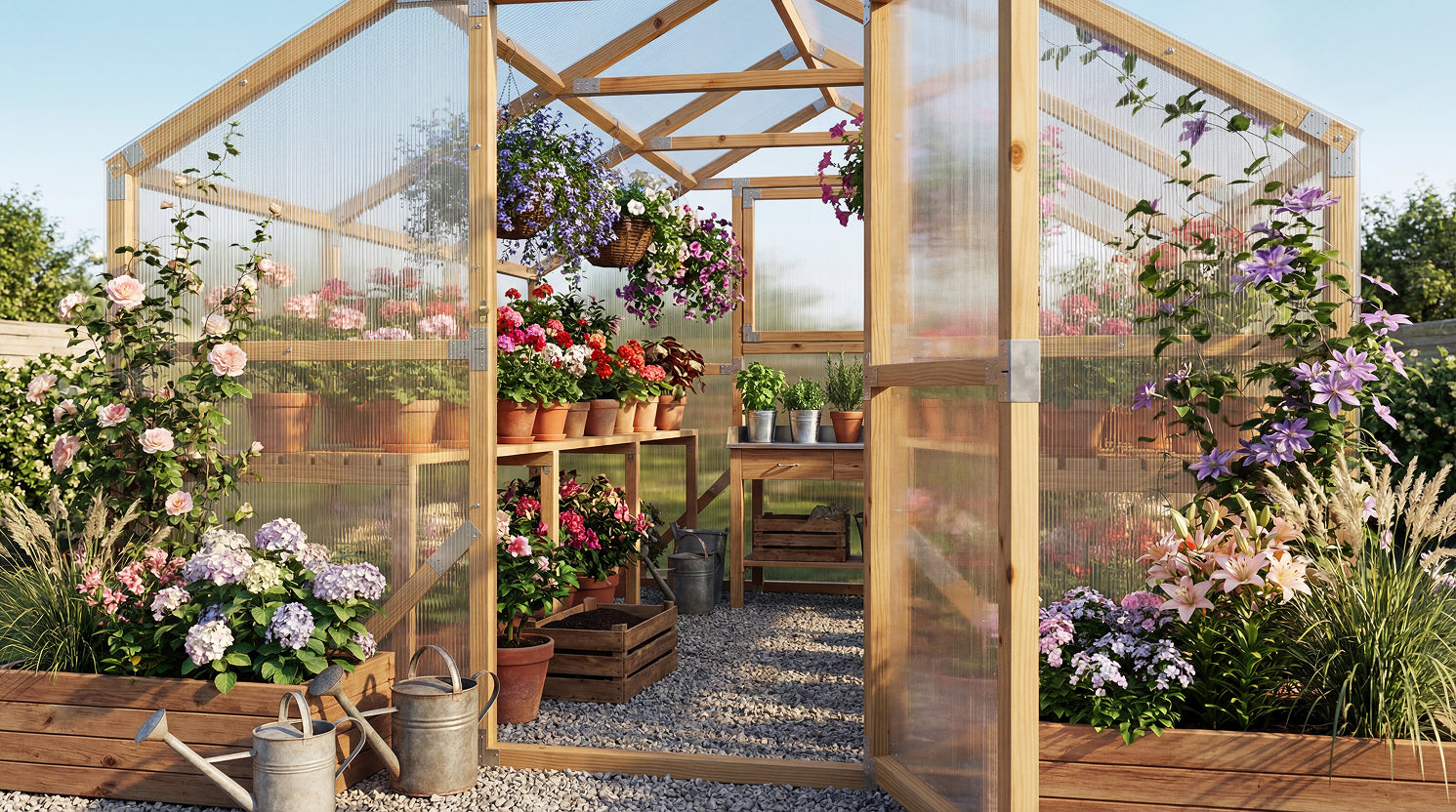
The physics is straightforward, and I'll keep it short. Aluminium conducts heat roughly 1,000 times faster than wood. That number sounds like marketing, but it's basic thermal conductivity. Aluminium sits at around 205 W/m·K. Timber is closer to 0.13 to 0.17 W/m·K. What this means in practical terms is that on a cold night, and in the UK those run from October to April, every section of aluminium in your greenhouse frame is actively pulling warmth out of your growing space and dumping it outside.
The frame becomes a radiator in reverse.
In practice, and owner reports on UK growing forums bear this out, a timber-framed greenhouse can hold 2 to 4°C warmer overnight compared to an equivalent aluminium structure with the same glazing. On a night when it drops to 3°C outside, that's the difference between your seedlings surviving and not. No extra heating, no fleece, just the frame doing its job.
For overwintering tender plants (dahlias, fuchsias, anything borderline hardy) that gap is large, and it adds up across every cold night of the year.
Side note: this is also why wooden greenhouses feel more pleasant to work in during shoulder seasons. The ambient temperature is just more stable. You're not suddenly cold the moment a cloud passes over.
2. Condensation Does More Than Annoy: It Kills Plants
Every aluminium greenhouse owner knows the drip. You open the door on a winter morning and there's a constant cold rain falling from the roof frame: water that condensed on the metal overnight and is now slowly pattering onto your propagation trays. Most people treat this as an inconvenience. It's actually worse than that.
Condensation on aluminium frames is persistent, and it creates exactly the microclimate that grey mould (Botrytis), damping off fungi, and bacterial rot need to thrive. The metal stays cold long after air temperature rises, which means the dripping doesn't stop when the sun comes out. It carries on for hours, soaking the growing medium, wetting foliage, creating standing water around roots.
A timber frame absorbs moisture rather than shedding it as drips. The wood buffers humidity swings, then releases moisture gradually back into the air as conditions warm. No system is perfect, but a timber frame is substantially better than a cold aluminium surface that acts as a permanent condensation point.
I'll be honest: condensation is what greenhouse owners raise most when they talk about switching from aluminium, more than temperature, more than looks. The incessant dripping was what finally wore them down.
3. That "Maintenance-Free" Claim Has Fine Print
Aluminium is sold relentlessly on the basis of low maintenance. In one narrow sense that's true: you don't paint it. But "maintenance-free" is doing a lot of heavy lifting there, because what aluminium requires instead is a different kind of ongoing attention, and the costs can be higher.
The glazing clips that hold glass panes into aluminium extrusions are plastic, and they degrade: in UV sunlight they become brittle within 3 to 5 years, and when they fail, panes start shifting, which is a problem in any wind. Replacement glazing clips cost a few pence each, but sourcing them for older models (anything 8+ years old) can be genuinely difficult, because the market is littered with slightly different proprietary sizes.
Then there's the glass itself. The standard glazing in budget aluminium greenhouses is 3mm horticultural glass, not safety glass. When a pane cracks (and they do, from hail, from footballs, from thermal stress), you're looking at £15 to £40 per pane, plus the challenge of cutting or sourcing the right size. Polycarbonate behaves differently: it flexes under a blow rather than shattering.
Now for the honest version of the wood side. Traditional wooden greenhouses do need repainting. Every 2 to 3 years, you're looking at sanding, treating, and repainting. It's a day's work, minimum, and if you skip it, you'll see rot within a decade. That's a real cost in time and money, and it's fair for aluminium sellers to point it out.
The reason we use FSC-certified pre-treated Swedish pine at Waldenhaus is precisely to change this equation. Our frames are factory pressure-treated, so the preservative penetrates the timber deeply rather than sitting on the surface. You still want to inspect and occasionally touch up exposed end-grain, particularly on the base sections. But you're not repainting an entire structure every couple of years. That's not part of our approach.
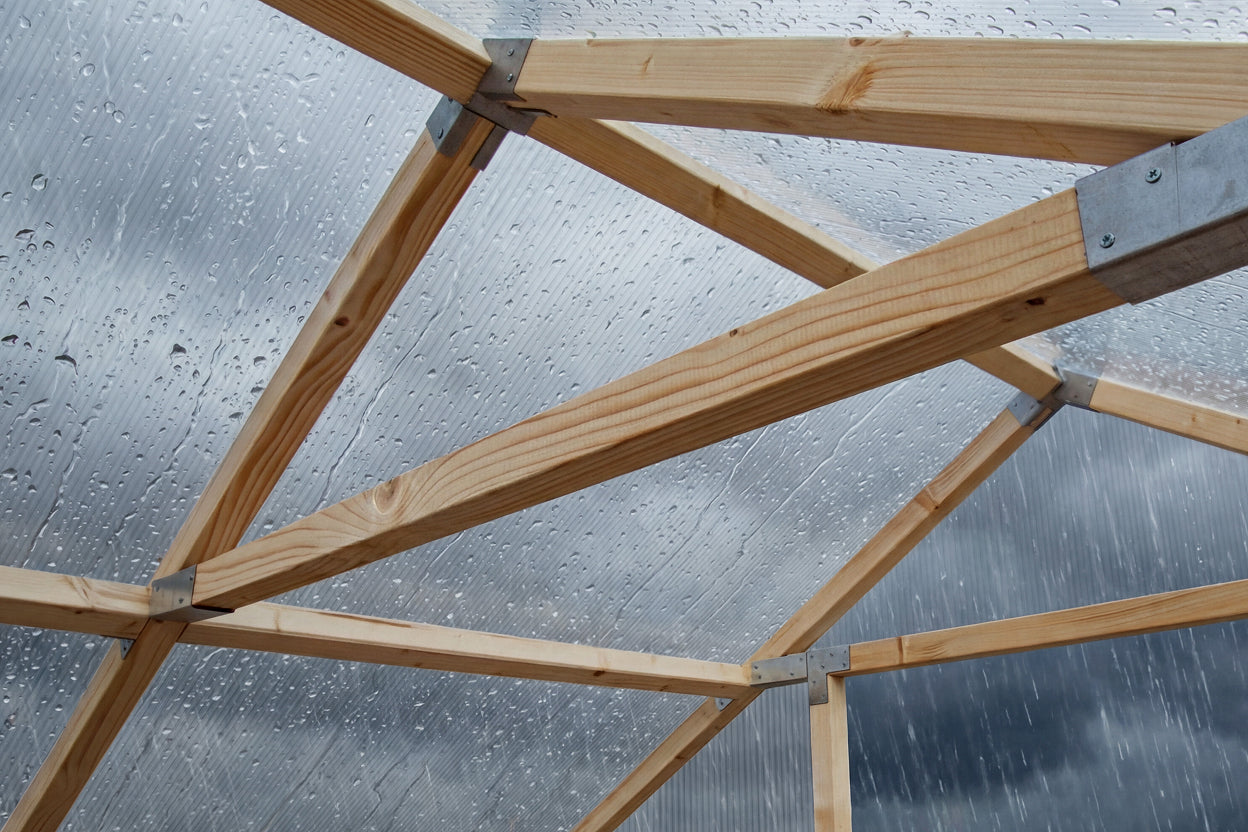

4. Wind Doesn't Care About Your Warranty
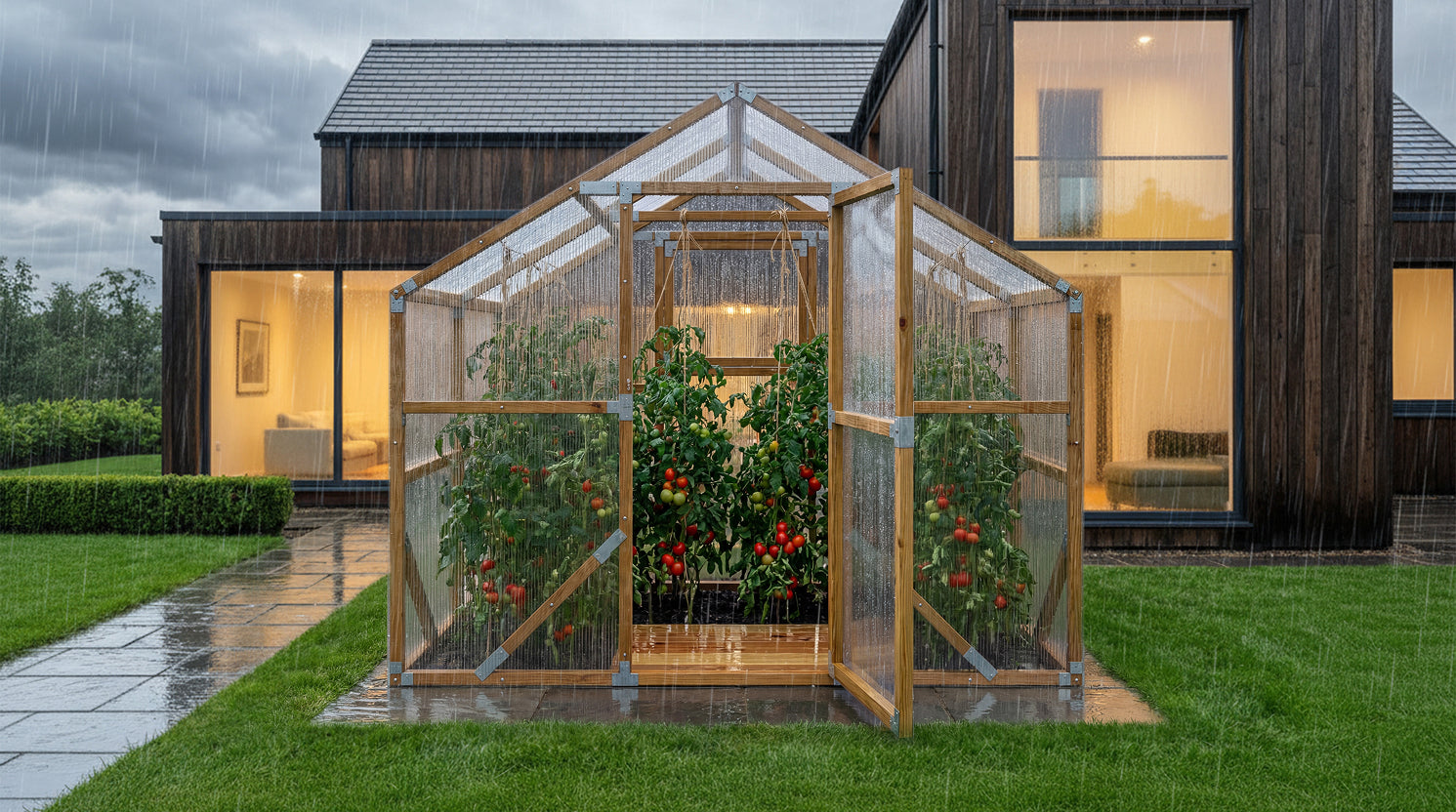
We learned this the hard way before Waldenhaus launched properly. Our first prototype used traditional mortise-and-tenon joinery, the classic woodworking approach, beautiful in furniture but genuinely unsuitable for a structure that's going to spend its life outside in a British garden.
Wood expands and contracts with moisture and temperature changes. In a timber-framed greenhouse, this means traditional joinery loosens over years. The tenons shrink slightly. The joints develop play. And in a wind event, play is what you don't want. One prototype developed a lean after two winters. Not catastrophic, but enough to see the problem clearly.
That's why every Waldenhaus joint uses galvanised steel brackets, alongside good timber engineering rather than instead of it. The steel carries the structural load at the connection points; the timber does everything else. The result is a frame that's genuinely rigid without being brittle.
Contrast that with a typical budget aluminium greenhouse. The extrusions are 1 to 2mm thick. You can flex a section by hand if you try. When the Atlantic systems that barrel through Wales and Scotland every autumn hit hard, those thin extrusions simply fold. The sections pull out of their corner connectors. Glass shatters outward.
Our ground-screw anchoring system is designed for British storm conditions, with screw-fixed glazing and Ground Screw Anchors at every load-bearing point. No concrete base needed: it anchors into compacted soil, paving, or decking. And because the frame is 45mm solid pine with steel at every joint, it doesn't flex like foil in a gust. It stands up the way a tree does, with weight and mass rather than springiness.
What fails in a storm is usually the glazing retention, not the frame metal. Panels that are only clipped in lift like sails in high wind, and a sprung clip lets go where a screw-fixed panel holds.
5. The Sound Thing Nobody Mentions
Rain on aluminium is loud. Genuinely, surprisingly loud, like working inside a snare drum.
This sounds trivial until you've spent time in both types. A timber-framed greenhouse with polycarbonate panels in a downpour is actually quite peaceful. The wood absorbs sound. The polycarbonate flexes slightly under impact rather than reverberating. You can hear yourself think. You might even enjoy it out there on a rainy afternoon in October.
An aluminium greenhouse in the same rain is the opposite experience. The thin frame resonates. Glass panels amplify the impact. If you plan to use your greenhouse as an actual place to spend time, potting, pruning, reading, whatever, that acoustic difference matters more than you'd expect.
Some gardeners say they stopped using their aluminium greenhouse on rainy days entirely because it was so unpleasant to be inside. Given that rainy days are a significant proportion of British gardening time, that's a meaningful loss of usable hours.

6. Resale Value: One Adds to Your Garden, the Other Doesn't
Estate agents have a phrase for features that increase property appeal without necessarily showing up directly in the sale price: "kerb appeal." A well-built timber greenhouse in an established garden is, unambiguously, kerb appeal. It reads as a garden feature. It photographs well. It suggests that someone has invested properly in the outdoor space.
A silver aluminium frame doesn't do that. It reads as a utility structure, the kind you walk past in a garden centre, temporary-looking rather than permanent. It isn't ugly, exactly, just neutral in a way that doesn't add story to a space.
This matters for two reasons. First, if you ever sell your home, a well-built timber greenhouse is part of what makes a garden desirable, not as a line item in the valuation, but in the overall impression the garden makes. Second, and honestly more important to most people: you're going to look at this thing from your kitchen window every day. Aesthetics aren't vanity; they're quality of life.

Waldenhaus sizes run from £999 (8x6 ft NORDIC-S) to £1,499 (8x20 ft NORDIC-XXL). At those price points, you're not paying garden-centre prices for a structure that looks like it belongs at a garden centre. You're getting something that belongs in the garden.
7. The Third Option Nobody's Talking About

Most wooden vs aluminium greenhouse debates assume those are the only two options, when they are not.
The traditional complaints about wooden greenhouses (repainting, rotting joints, heavy maintenance) come almost entirely from older designs using traditional joinery and single-layer glass. The traditional complaints about aluminium (cold, condensation, fragility, noise) come from the material itself and can't really be engineered away.
The Waldenhaus approach combines a timber frame with polycarbonate panels and steel-reinforced joints. Not because we couldn't figure out how to do glass, but because polycarbonate is genuinely better for most growing applications. Our CrystalLight 4mm twin-wall panels diffuse light well, with no harsh hotspots on foliage and no shadow striping from pane divisions, and they don't shatter. If a storm throws a branch against a Waldenhaus panel, you get a ding at worst. Not a hole. Not shards on your propagation bench.
The result is a structure that keeps the thermal and acoustic benefits of timber, removes the maintenance headaches of traditional wooden greenhouses, and doesn't carry the fragility or cold problems of aluminium. It sits in a category of its own. The Nordic Greenhouse runs from £999 for the 8x6 ft NORDIC-S right up to £1,499 for the 6m, and EasyMount assembly means two people can have it standing over a weekend without digging a concrete base.
Learn more about our materials and construction approach, or browse the full Nordic Greenhouse range.
If a timber frame sounds like the right call for your garden, you can compare all five sizes (8x6 ft to 8x20 ft, £999 to £1,499) in the NORDIC wooden greenhouse collection.
When Aluminium Actually Wins
I said this would be balanced, so here's where aluminium genuinely makes sense.
- Budget under £500. The honest truth is that at sub-£500, you're not getting quality timber. You're getting cheap softwood that will rot within a few years. Budget aluminium structures aren't great, but they're at least consistently what they are. If your budget is under £500, aluminium is the safer bet, just don't expect it to last a decade.
- Completely low-maintenance tolerance. If you genuinely will not do any maintenance ever, no checking, no touching up, no anything, then aluminium is more forgiving. A well-built timber structure with pre-treated pine has very low maintenance requirements, but it's not zero. If that's a dealbreaker, aluminium suits you better.
- Temporary or rental situation. If you're renting a garden, or you know you'll be moving within two years, a cheap aluminium greenhouse makes financial sense. Put it up, take it down, leave it or sell it. No sunk cost.
- Growing environment near industrial pollution. Aluminium can corrode where the water or air carries high copper content or pollution from nearby industrial processes, and even in those conditions timber holds up better as a long-term material.
That is the honest version, edge cases and all.
Quick Comparison: 7 Key Factors
| Factor | Budget Aluminium | Waldenhaus Timber + Polycarbonate |
|---|---|---|
| Night temperature retention | Poor: frame conducts heat out | 2 to 4°C warmer overnight |
| Condensation | High: persistent dripping | Low: timber buffers humidity |
| Wind resistance | 1 to 2mm extrusions; folds in storms | 45mm pine + steel joints; engineered for British storm conditions |
| Glazing safety | 3mm glass: shatters | 4mm twin-wall polycarbonate: flexes |
| Noise | Loud in rain | Quiet: timber absorbs sound |
| Long-term maintenance | Clip replacement, glass sourcing | Low: pre-treated pine, no clips |
| Garden aesthetics | Functional/utility look | Garden feature; adds appeal |
FAQ
Which is better, a wooden or aluminium greenhouse?
There's no single winner: a wooden vs aluminium greenhouse decision depends on what you value. Aluminium wins on lowest upfront cost, light self-build weight and zero rot risk. A wooden greenhouse wins on shoulder-season warmth, a quieter feel in rain, and looking like part of the garden rather than a utility frame. If you want the timber benefits without traditional joinery that traps moisture, our NORDIC range pairs 45×45 mm FSC Swedish pine with 4 mm CrystalLight twin-wall polycarbonate and re-treatment only every 2 years.
Do wooden greenhouses rot?
Traditional ones can, yes, particularly if the timber isn't treated properly and if traditional joinery is used (moisture sits in the joints). Modern pre-treated timber, like the FSC Swedish pine we use, behaves very differently. The factory pressure treatment means preservative penetrates the wood rather than coating the surface. You'll want to keep the base sections off standing water and check end-grain on cut sections, but rot isn't the inevitable outcome it was with older-style wooden greenhouses. Ours come with a frame warranty for exactly that reason.
Is an aluminium greenhouse easier to assemble?
Generally, yes, the sections slot together quickly. But "easy" is relative. The fiddly bit with aluminium is the glazing: getting glass panes seated correctly, clips in the right position, seals compressed evenly. People underestimate how long that takes. Our EasyMount system means a 4m Waldenhaus goes up over a weekend with two people, no specialist tools, no concrete. It's not dramatically slower than aluminium in practice.
What about timber greenhouse vs metal for growing tomatoes specifically?
Timber wins, primarily because of the overnight temperature retention. Tomatoes are the classic example of a crop that needs warm nights as much as warm days: below about 10°C overnight, fruit set stops. Those extra 2 to 4°C from a timber frame can extend your productive season by three to four weeks at either end of the year in most of the UK. For anyone outside the Home Counties growing tomatoes, that matters.
Are wooden greenhouses more expensive?
Quality timber greenhouses tend to cost more upfront than budget aluminium, yes. Our Nordic Greenhouse starts at £999 for the 8x6 ft NORDIC-S. But the comparison should really be on a 10 to 15 year timeframe: factor in glass replacement, clip degradation, and the probability of storm damage to a thin aluminium frame, and the cost difference narrows considerably. Cheap aluminium isn't cheap over a decade.
→ Deeper read: Rhino greenhouse vs NORDIC, an honest 2026 comparison. The same 10 to 15 year lens, applied to the premium end of aluminium.
What are the main aluminium greenhouse problems to watch for?
Four issues come up repeatedly with budget greenhouses: glazing clip failure (typically from year 3 onward), frame corrosion in certain environments (particularly areas with high atmospheric copper, which some Reddit users in industrial areas report within 5 to 7 years), condensation-related plant loss over winter, and structural failure in wind events. None of these are guaranteed, but all are common enough to be recurring topics.
Ready to see the Nordic Greenhouse range? From 2m to 6m, FSC Swedish pine with CrystalLight polycarbonate, assembled in a weekend. Browse the full range →
Written by the Waldenhaus team. We've been growing under glass (and polycarbonate) for years, and spent two years developing the Nordic Greenhouse range before launching Waldenhaus. Most of what we grow is tomatoes, dahlias, and things that have no business surviving a British winter.
Choose your NORDIC wooden greenhouse
By size
- 8x6 ft, NORDIC-S £999 · patio / starter / small allotment
- 8x10 ft, NORDIC-M from £1,199 · family veg garden sweet spot
- 8x13 ft, NORDIC-L from £1,299 · serious year-round growing
- 8x16 ft, NORDIC-XL from £1,399 · multi-crop with two ground beds
- 8x20 ft, NORDIC-XXL from £1,499 · walk-in / market grower
By configuration
- Lean-to wooden greenhouse · wall-mount, space-efficient
- Polycarbonate greenhouses UK · 4 mm CrystalLight glazing detail
Decide before you buy
- Greenhouse Buying Guide UK 2026 · full step-by-step framework
- Wooden Greenhouses overview · the NORDIC range explained
- Shop the NORDIC range, from £999
See also: Polycarbonate Wooden Greenhouse, NORDIC range built for British weather · Wooden Greenhouse Buying Guide UK 2026
Cost over 10 years: see the full pricing breakdown in Wooden Greenhouse Cost UK 2026.
Related Reading
- Polycarbonate wooden greenhouse, built for British weather
- Small wooden greenhouse, NORDIC-S detail
- Large wooden greenhouse, NORDIC L, XL, XXL
- How to assemble a wooden greenhouse (UK)
- How to insulate a greenhouse for UK winter
- Waldenhaus wooden greenhouses, main hub
- Shop the NORDIC range, from £999
The 10-year reality: maintenance, real costs and who should pick which
The frame you choose decides what your future autumns look like. Aluminium asks for very little. Timber asks for a couple of hours and a tin of plant-safe preserver every other year. Here is the honest year-by-year picture, with the jobs the brochures tend to skip.
What each frame actually needs
| Job | Timber frame | Aluminium frame |
|---|---|---|
| Re-treat the wood | Plant-safe preserver every other year keeps the timber sound | Never required |
| Hygiene clean | At least once a year (RHS); we do ours in autumn, after the summer crops finish | At least once a year (RHS); we do ours in autumn, after the summer crops finish |
| Glazing checks | Putty or beading checked at the annual clean | W-clips work loose in wind; replace the whole row when re-glazing |
| Inspect for damage | Check joints and base rail for soft spots once a year | Check for loose bolts and lifted panels after high winds |
The RHS puts it plainly: aluminium "needs no upkeep", while wood "needs periodic upkeep". Both still earn the same annual clean, which the RHS recommends at least once a year to cut the places pests and disease spores can overwinter, so neither frame is truly hands-off.
Cost across a decade (illustrative)
| Frame | Upfront | Upkeep over 10 years | What you spend it on |
|---|---|---|---|
| Aluminium | Lower | Minimal | A bag of replacement clips, the odd pane |
| Timber | Higher | A few tins of preserver plus your weekends | Preserver every other year, occasional putty |
Treat the figures as direction, not a quote. With timber, the decisive cost is time rather than money: a re-treatment session every other year across the decade.
Who should pick which
- Pick aluminium if you want to clean once a year and forget the frame, or you are renting and want resale simplicity.
- Pick timber if warmth, looks and quietness matter, and a weekend with a brush every other autumn sounds like time well spent.
Settle one question before you order: will you genuinely re-treat timber on schedule? If yes, wood rewards you. If the brush will gather dust, aluminium is the kinder choice.
Sources & further reading
- Planning Portal: Outbuildings, the permitted development rules that decide whether a garden greenhouse needs planning permission.
- Met Office: UK Storm Centre, the named Atlantic storm systems every British garden structure has to stand up to.
- HSE: Workplace health, safety and welfare (L24), the official UK guidance on glazing safety and safety materials, which standard 3 mm horticultural glass does not meet.
- FSC: FSC labels, what FSC certification on timber actually guarantees about where the wood comes from.
- RHS: Grey mould, why the damp conditions behind persistent condensation favour Botrytis.


