

Updated April 2026: figures and temperature data revised to reflect the 2025-26 growing season.
Written by the Waldenhaus team
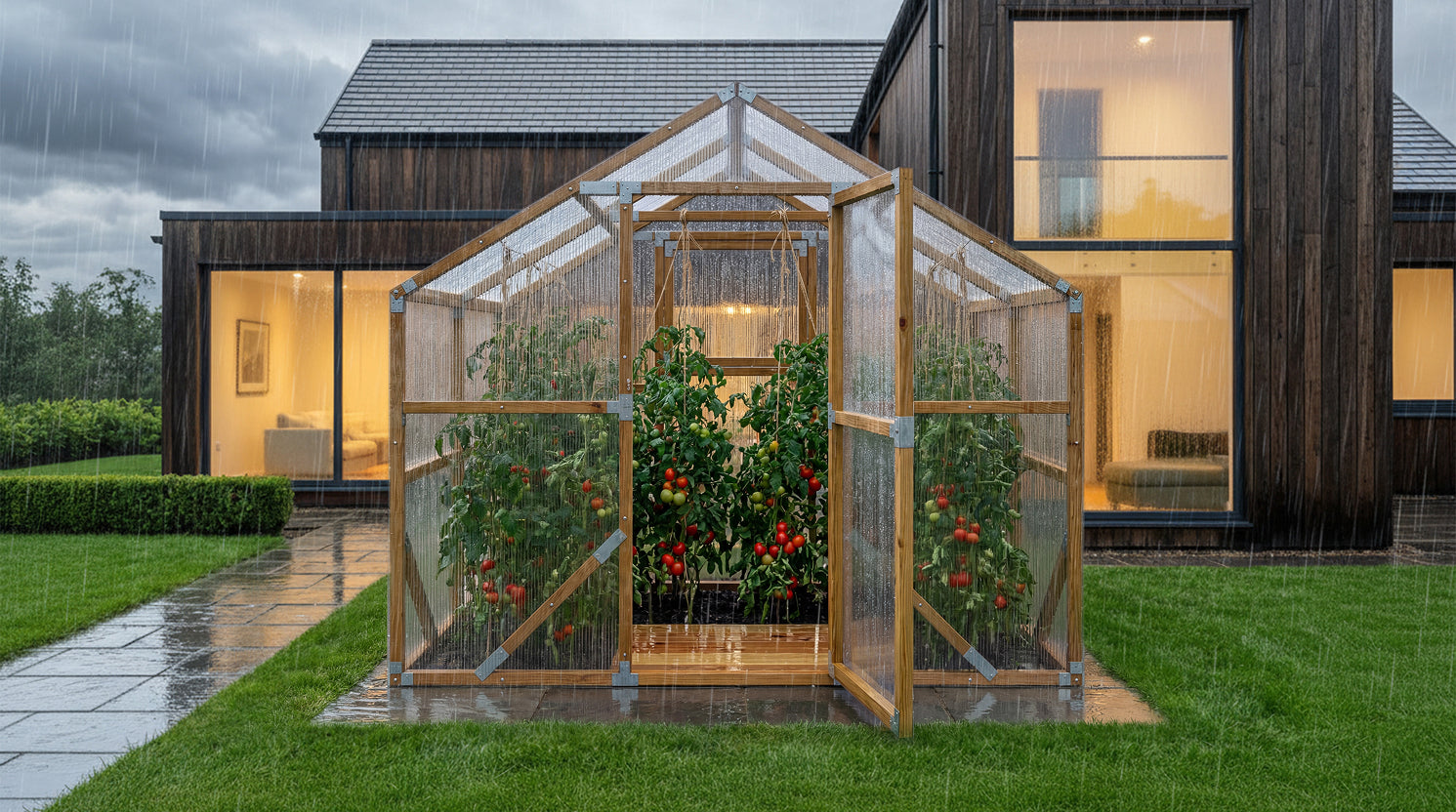
On a hard January night, the instinct is that glass, the traditional choice, must make the better greenhouse. Winter physics says otherwise.
A single pane of horticultural glass has no insulating air gap, so it loses heat roughly 40% faster than 4mm twin-wall polycarbonate, where sealed cells trap a layer of still air. That single difference is why an unheated polycarbonate greenhouse holds a higher overnight minimum than a single-glazed structure in the same garden, and why the glazing you choose matters more in a UK winter than how it looks on a summer afternoon.
The short version is that, for most UK growing conditions, polycarbonate performs more effectively than traditional horticultural glass as a greenhouse glazing material.
That said, the verdict flips in a few scenarios where glass remains the better choice, and those are worth understanding.
The Nordic Greenhouse uses 4mm twin-wall CrystalLight polycarbonate panels within an FSC-certified Swedish pine frame. The adjacent cold frame is a standard aluminium-framed unit with 6mm horticultural glass.
These are real-world structures rather than a laboratory test: they differ in volume, thermal mass and configuration. The observed temperature differential is consistent with the known thermal properties of the materials.
Here is why.

Light transmission: the numbers
Standard 4mm horticultural glass transmits approximately 90% of visible light. Our 4mm CrystalLight twin-wall polycarbonate transmits around 83%.
That represents a real difference of roughly 5-10 percentage points, and it is often cited in glass vs polycarbonate greenhouse comparisons as a primary argument in favour of glass.
The figure itself is accurate.
Light transmission alone does not fully describe how light behaves once it enters a growing environment.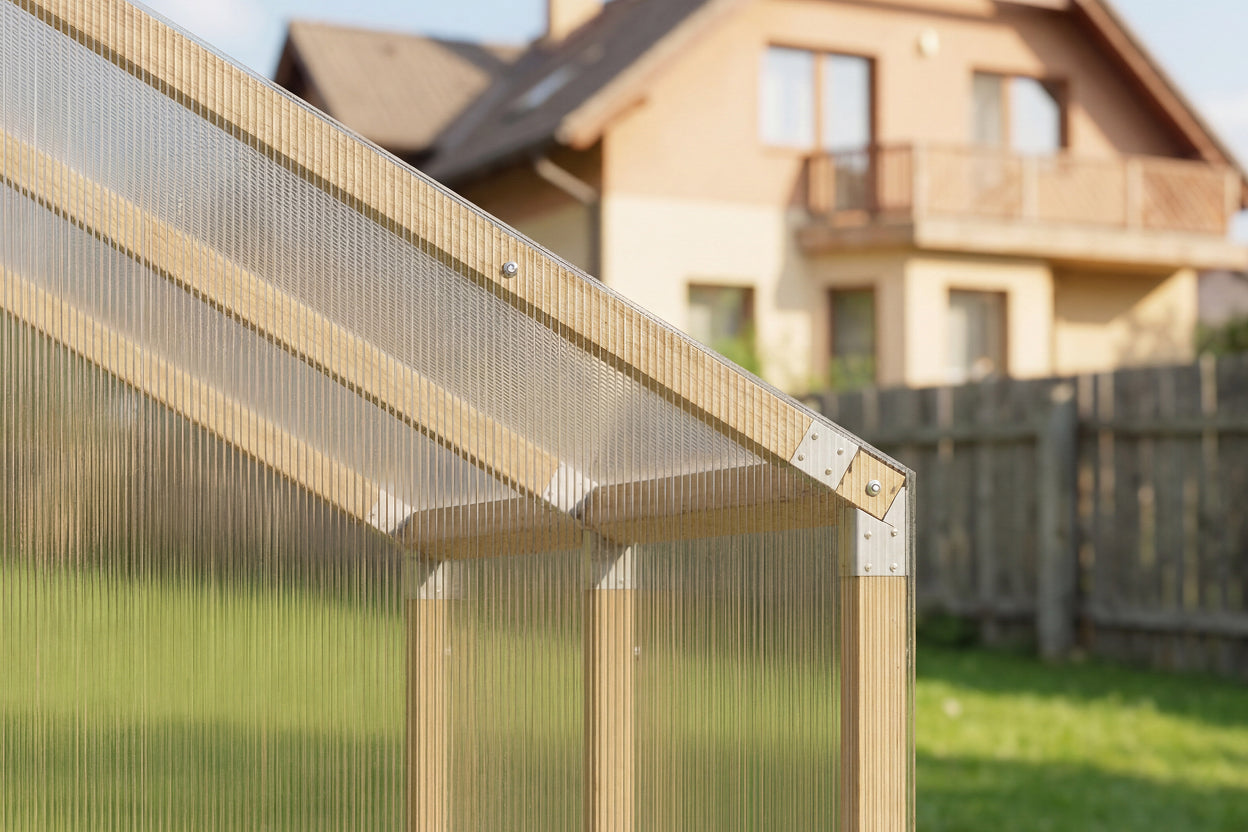
What actually matters for your plants
Light diffusion vs direct transmission
Glass transmits largely direct, collimated light. Polycarbonate, particularly twin-wall structures, diffuses incoming light, scattering it across multiple angles as it passes through the panel.
In horticultural terms, this changes how light is distributed within the canopy.
Rather than concentrating light intensity at the top of the plant, diffused light spreads more evenly throughout the structure. As a result, lower and inner leaves receive a higher proportion of usable light.
This matters because photosynthesis depends on the total distribution of photosynthetically active radiation (PAR) across the plant as a whole, and peak light intensity at the top of the canopy is only one part of that.
There is well-established horticultural research supporting this effect. In commercial greenhouse production, particularly in regions such as the Netherlands, diffuse glazing systems have increasingly been adopted to improve yield consistency and canopy penetration.
In practice, this can result in more even growth and improved use of available light, particularly in dense crops such as tomatoes.
Practical implications
One of the most noticeable differences is the reduction of localised light intensity peaks.
Glass can, in certain conditions, produce concentrated light hotspots, particularly where direct sunlight passes through at sharp angles or interacts with minor surface imperfections.
In some cases, this can stress young or delicate seedlings during strong spring sunlight.
Polycarbonate reduces this effect considerably because of its light-scattering properties.
Exceptions and context
There are situations where maximum direct light transmission remains advantageous, for example in specialist orchid cultivation or high-light desert species such as certain cacti.
For most UK greenhouse applications, including tomatoes, peppers, cucumbers, herbs, and seedling propagation, the difference in total transmitted light (approximately 5-10%) is rarely the limiting factor.
In UK conditions, the primary constraint for most of the year is overall light availability rather than marginal gains in transmission efficiency.
Heat retention in a UK winter
What the U-value difference means overnight
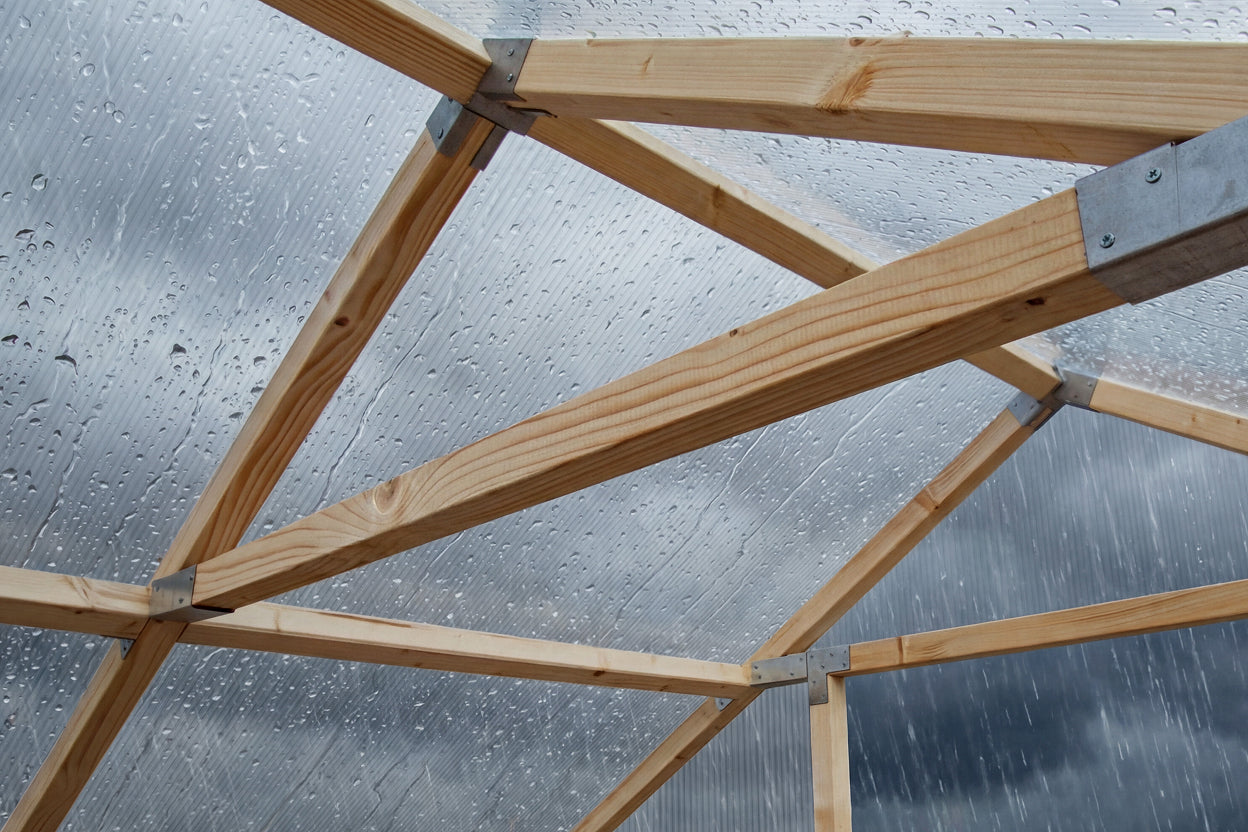
The honest way to compare two glazing materials is through their thermal transmittance, not a single anecdote. Single horticultural glass sits around 5.6-5.8 W/m²K; 4mm twin-wall polycarbonate sits around 3.5 W/m²K, so the polycarbonate loses roughly 35-40% less heat per degree of temperature difference.
In practice, that lower heat loss means an unheated twin-wall structure holds a higher overnight minimum than a single-glazed one in the same conditions, and the gap widens on the coldest nights, when the difference between inside and out is greatest. A cold frame glazed with single glass, low and uninsulated, sheds that heat fastest of all.
Why this changes the interpretation
Thermal performance in glazing systems is typically described using either U-value (heat loss per square metre per degree of temperature difference, W/m²K) or its inverse, R-value (thermal resistance).
These values help explain why twin-wall polycarbonate performs differently from single-pane glass in real-world conditions, particularly under the low-temperature overnight conditions typical of UK winters.
| Material | Thickness | U-value (W/m²K) | R-value (approx.) |
|---|---|---|---|
| Single glass | 4mm | 5.8 | 0.17 |
| Single glass | 6mm | 5.6 | 0.18 |
| Double glass (IGU) | 24mm | 2.9 | 0.34 |
| 4mm twin-wall polycarbonate (CrystalLight) | 4mm | 3.5 | 0.29 |
Single glazing typically has a U-value of around 5.6-5.8 W/m²K. Our 4mm twin-wall polycarbonate is approximately 3.5 W/m²K.
This corresponds to roughly 35-40% lower heat loss per degree of temperature difference compared to single-pane glass.
In UK winter conditions, where the difference between external temperatures and a target growing temperature of around 10°C can be significant, this difference becomes materially relevant over extended cold periods.
It affects both energy consumption in heated greenhouses and passive temperature retention in unheated structures.
In practical terms, heating a glass greenhouse to 10°C on a January night will generally require more energy than maintaining the same temperature in an equivalent polycarbonate structure.
Over a full winter season, the difference in electricity consumption for a small heated 3m greenhouse could, as an illustrative estimate, be in the region of £80-£120. Actual costs depend on tariff, insulation, exposure, and heating method.
On the same illustrative basis, this could represent £400-£600 over five years, before considering maintenance or component replacement.
Wind and impact: the repair-bill difference
Why screw-fixing matters in high wind
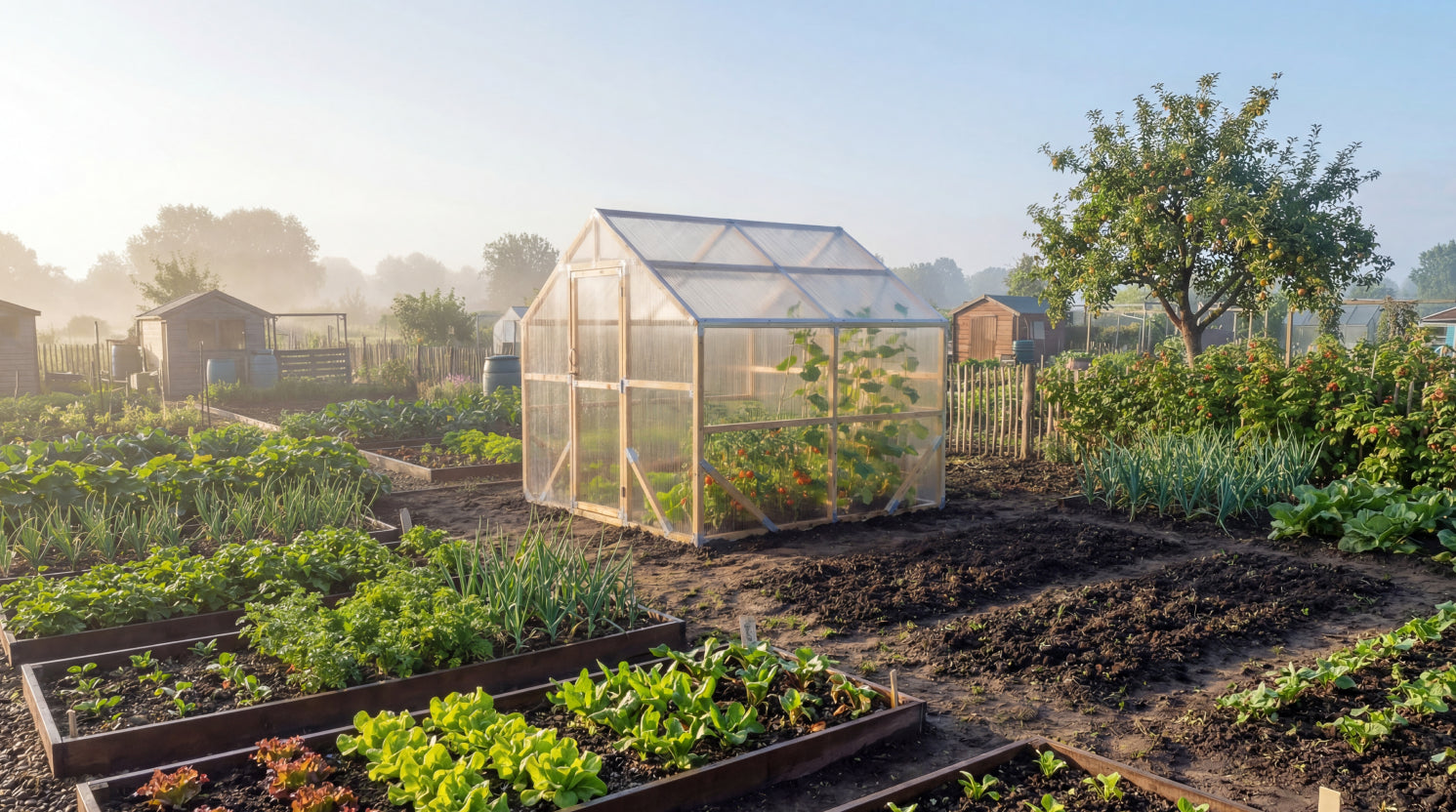
The failure mode in high wind is well understood: a lightweight panel that is only sprung or clipped in can lift like a sail and pop out, and a glass pane that shifts in its clips can crack or fall. The answer is mechanical restraint. NORDIC panels are screw-fixed to the frame at every edge, and the structure anchors with a ground-screw system rather than resting on its own weight.
For owners of older glass structures, replacing panes after a windy spell tends to become a predictable running cost rather than a rare event.
Weight matters: glass vs polycarbonate
Standard 4mm horticultural glass weighs approximately 7.5kg per square metre. Our 4mm CrystalLight twin-wall polycarbonate weighs around 1.2kg per square metre.
This represents a weight difference of more than six times for equivalent surface area.
In practical terms, polycarbonate panels do not shatter under impact, and they do not fragment into sharp debris under failure conditions. Glass, by contrast, fails in brittle fracture, producing high-energy shards that fall under full panel weight.
This difference has both performance and safety implications, particularly in older structures where glazing systems may have aged over time.
The trade-off with lightweight panels is increased sensitivity to wind uplift. For this reason, the Nordic Greenhouse includes a dedicated ground-screw anchoring system as part of its standard structural design.
The panels are screw-fixed directly to the frame, and the structure anchors with a ground-screw system rather than relying on its own weight.
Safety: families, schools, allotments
Polycarbonate is considerably more impact-resistant than standard horticultural glass, with industry comparisons typically placing it at up to 200 times greater resistance under equivalent thickness conditions.
Toughened glass sits between the two. Standard horticultural glass is annealed and breaks into long, sharp shards; toughened panes are heat-treated, roughly four to five times more resistant to breakage, and crumble into small blunt granules when they do fail. Many suppliers offer toughened glazing as a safety upgrade for exactly this reason. It still fails outright on a hard point impact, particularly at edges and corners, and every failure means a full pane replacement, so the gap to polycarbonate narrows without closing.
In practical terms, this means it is highly resistant to accidental impact from garden use, including tools, sports equipment, and animals, where glass would typically fail.
This makes it particularly relevant in shared or high-activity environments such as family gardens, school growing spaces, and allotment sites with close pedestrian access.
There is also a handling difference during installation and maintenance. Glass requires careful handling because of breakage risk and sharp edge exposure. Polycarbonate panels can generally be cut and installed with standard tools, and do not carry the same risk of sharp fragmentation during routine work.

Cost comparison: five-year cost of ownership
This is where the conversation usually shifts. People buy on upfront price and regret it when the 5-year costs arrive. Consider the whole picture: a medium-sized 3m greenhouse, UK winter heating costs, average storm damage frequency, and maintenance.
| Cost Category | Traditional Glass Greenhouse | Waldenhaus Nordic Greenhouse (Polycarbonate) |
|---|---|---|
| Initial purchase (3m) | £850-£1,200 (aluminium frame, single glass) | £1,199 (FSC pine frame, CrystalLight panels) |
| Installation | £0-£200 (base often needed) | £0 (no concrete base required, EasyMount assembly) |
| Pane replacement over 5 years (illustrative assumption: 1-2 panes/yr) | £300-£450 | £0-£50 |
| Additional winter heating (glass loses ~40% more heat) | £400-£600 over 5 winters | £0 saving vs glass |
| Frame maintenance (paint, treatment) | £0 (aluminium) | £40-£80 (re-oiling pine every 2-3 years) |
| Estimated 5-year total | £1,600-£2,400 | £1,639-£1,830 |
Prices checked July 2026. Polycarbonate side: live NORDIC prices, £999 (NORDIC-S) to £1,499 (NORDIC-XXL) across the five sizes. Glass side: indicative UK ranges for an aluminium-framed, single-glazed structure of similar size, typically from £850.
The upfront cost of a glass greenhouse can appear lower on day one. Over a longer ownership period, this comparison typically changes. By year two or three, ongoing maintenance and replacement costs begin to accumulate. By year five, the total cost difference can become significant, often in the range of £400 to over £1,000, depending on the number of pane replacements required and heating usage.
One important caveat is installation context. If a suitable concrete or paved base already exists from a previous structure, installation costs for a glass greenhouse may also be reduced. This should be factored into any like-for-like comparison. The advantage of a no-foundation system is most relevant for installations on grass, soil, or previously unused garden areas.
Labour input is also worth considering. Glass pane replacement typically involves measuring, sourcing, waiting for delivery, and re-glazing. For most users, each incident requires approximately 2-3 hours of time.
When included in a full cost-of-ownership assessment, this time investment can represent a meaningful additional cost, depending on how personal time is valued.
When glass is actually better
There are situations where glass remains the more appropriate choice, and it is important to acknowledge those clearly.
Show gardens and heritage settings
For formal gardens, heritage properties, or display environments such as walled kitchen gardens or RHS-style show settings, glass often remains the preferred material.
The visual characteristics of glass, including its optical clarity and reflective properties at low sun angles, contribute to a traditional appearance that polycarbonate does not replicate in the same way.
Polycarbonate, by contrast, has a more diffuse optical profile. While this helps light distribution in growing environments, it is less aligned with purely aesthetic or heritage-driven design requirements.
Specialist high-light cultivation
In high-demand light environments, where crops require maximum daily light integral (DLI), the additional 5-10% transmission provided by glass can be relevant.
This is most applicable to specialist cultivation such as certain orchids, cacti, or high-light Mediterranean crops grown under UK conditions.
For general greenhouse use, including tomatoes, peppers, cucumbers, and herbs, this difference is typically not the limiting factor in performance.
Long-term longevity considerations
A well-maintained glass greenhouse structure can remain in service for multiple decades, with lifespans of 50 years or more being achievable in appropriate conditions.
By comparison, polycarbonate glazing typically has an expected service life of approximately 15-25 years before gradual UV-related degradation may affect optical clarity and performance, even in UV-stabilised materials.
In most greenhouse systems, glazing is the most replaceable component. Frame integrity and structural systems typically represent the dominant long-term durability factor.
Double-glazed systems
Double-glazed horticultural glass units (IGUs) can reduce the thermal performance gap between glass and polycarbonate.
Typical U-values for double glazing are approximately 2.8-3.0 W/m²K, compared to around 3.5 W/m²K for 4mm twin-wall polycarbonate.
While this narrows the thermal difference, double-glazed greenhouse systems are significantly more expensive and heavier, and therefore less commonly used in domestic horticultural applications.
Summary
These scenarios represent specific use cases rather than the typical requirements of most UK gardeners.
For general-purpose growing, particularly where year-round usability, thermal stability, and durability under UK weather conditions are priorities, twin-wall polycarbonate systems are more commonly selected.
Glass remains a valid choice where aesthetics, heritage context, or specialist light requirements are the primary drivers.
Why we chose CrystalLight polycarbonate for NORDIC
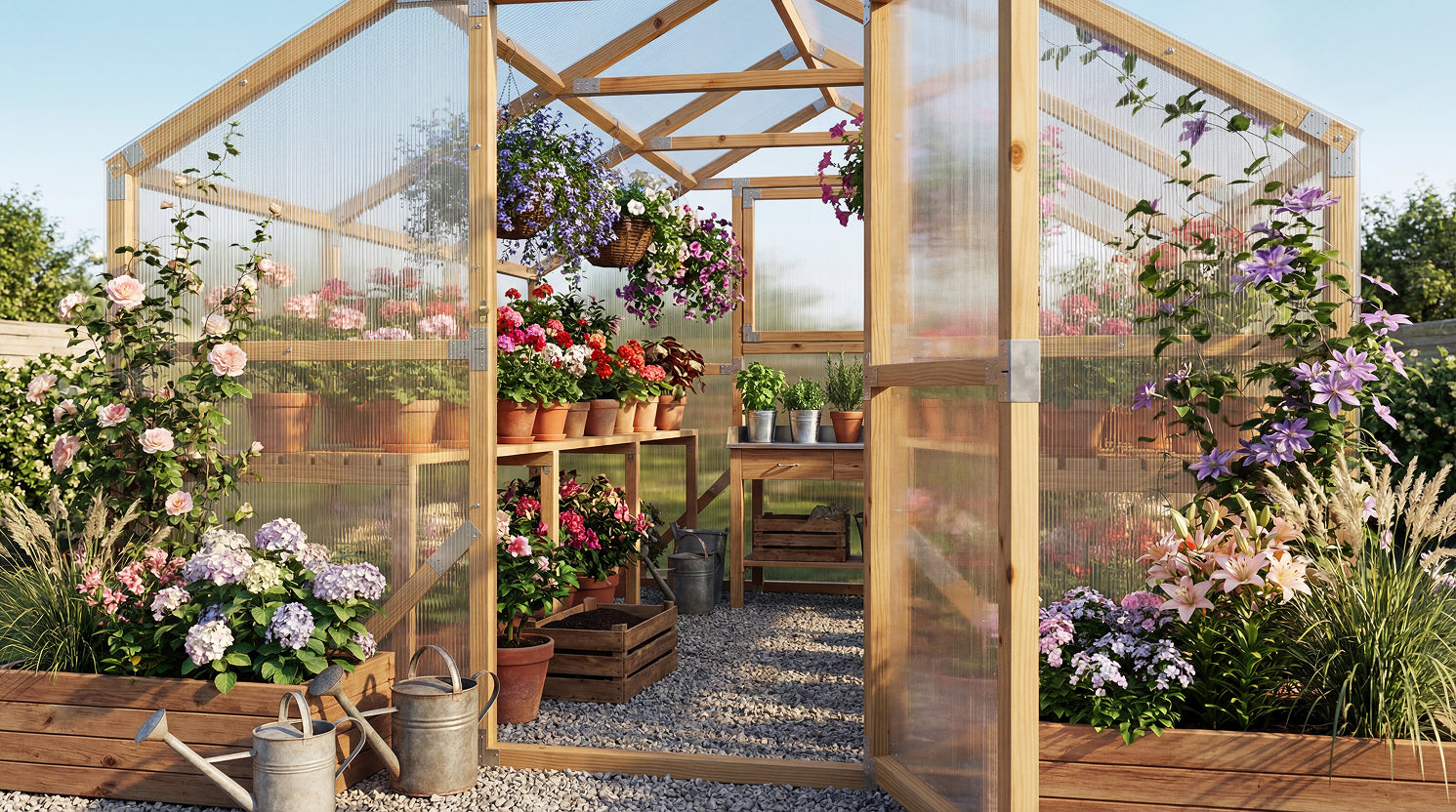
Design rationale: glazing and frame system
The glazing specification for the NORDIC range comes down to a clear set of trade-offs between glass and polycarbonate in a timber frame.
Glass in a pine frame gives strong optical clarity, but it is heavy: a 6mm glass skin loads the joints and makes post-damage repair more involved. That points to the core constraint, a lightweight glazing system that suits a low-maintenance timber structure.
Why 4mm twin-wall, not 2mm or 10mm
The three common polycarbonate options trade insulation, light and rigidity against each other:
- 2mm single-wall panels offer low structural rigidity and little thermal benefit over glass
- 10mm triple-wall panels provide high insulation but reduce overall light transmission to a level considered suboptimal for general-purpose horticultural use
- 4mm twin-wall sits in the balance, across thermal efficiency, structural weight and light diffusion
For this reason, 4mm twin-wall is the baseline glazing for the NORDIC range.
CrystalLight panel characteristics
The CrystalLight specification incorporates the following characteristics:
- Dual-sided UV stabilisation to improve long-term clarity and reduce degradation risk
- Light transmission of around 83%
- Reinforced internal cell geometry designed to improve rigidity without increasing panel mass
Compared to standard twin-wall polycarbonate within the same category, this configuration is built for dimensional stability under temperature variation and structural load consistency.
Frame material considerations
The choice of frame material has a direct influence on both thermal performance and user experience.

Aluminium, while widely used in greenhouse construction, has high thermal conductivity relative to timber, resulting in increased heat transfer at structural junctions (thermal bridging).
FSC-certified Swedish pine provides much lower thermal conductivity, reducing heat loss at frame contact points and contributing to improved internal temperature stability under identical glazing conditions.
From a structural perspective, timber also allows for increased section depth, which can improve rigidity without reliance on thin metal extrusions.
Steel is the third frame route. Our SteelRoot arch greenhouse pairs a 1.2 mm galvanised steel frame with the same 4 mm twin-wall polycarbonate; arches sit at 1.0 m spacing as standard, with a 0.67 m close-arch option for exposed plots, and prices start at £899.

The Nordic Greenhouse is available in five sizes from 2m to 6m. NORDIC-S starts at £999. NORDIC-XL (£1,399) and NORDIC-XXL (£1,499) are the largest in the range. Two people can typically complete the EasyMount assembly over a weekend without specialist tools, and it doesn’t require a concrete base. It anchors securely into compacted soil or an existing paved surface.
If you want to have a look at the full specification, the Nordic Greenhouse product page has panel dimensions, anchoring details, and a downloadable assembly guide.
Is polycarbonate or glass better for a greenhouse in the UK?
For most UK gardening conditions, twin-wall polycarbonate is the more practical choice.
Compared to single horticultural glass, it offers improved thermal retention, higher impact resistance, and lower long-term maintenance requirements. The trade-off is lower peak light transmission (around 83% vs ~90%) and a more diffuse visual appearance.
Glass remains appropriate for heritage gardens, show settings, or specialist cultivation where maximum light transmission or traditional aesthetics are the primary requirement.
How much warmer is a polycarbonate greenhouse than a glass greenhouse?
The dependable answer comes from the materials rather than a single test. Twin-wall polycarbonate (about 3.5 W/m²K) loses roughly 35-40% less heat per degree than single horticultural glass (5.6-5.8 W/m²K), so an unheated polycarbonate greenhouse holds a higher overnight minimum than an adjacent single-glazed cold frame.
The difference is most pronounced during colder nights (below freezing conditions) and narrows under milder conditions.
This aligns with the difference in thermal transmittance values:
- Single glass: approximately 5.6-5.8 W/m²K
- Twin-wall polycarbonate: approximately 3.5 W/m²K
Lower heat loss also reduces energy demand in heated systems, with seasonal savings in small domestic setups typically varying depending on exposure, insulation, and heating method.
Does polycarbonate yellow over time?
Lower-grade, non-UV-stabilised polycarbonate can yellow, haze, and become brittle within 5-8 years.
High-quality horticultural-grade panels use co-extruded UV protection layers designed to reduce this effect considerably. In such systems, expected service life is typically 15-25 years under normal exposure conditions.
Long-term performance depends primarily on UV stabilisation quality rather than the polycarbonate material itself.
Can you see through polycarbonate greenhouse panels?
Twin-wall polycarbonate is translucent rather than transparent.
It transmits light while diffusing visual detail, meaning shapes and outlines are not clearly visible through the panel. From the exterior, it appears similar to frosted glass; from the interior, it produces bright, evenly distributed light without clear external visibility.
This is a functional characteristic rather than a defect: diffusion improves internal light distribution across the plant canopy.
How long does polycarbonate last on a greenhouse?
High-quality UV-stabilised polycarbonate panels typically have a service life of approximately 15-25 years.
Degradation is primarily driven by UV exposure and surface weathering, which can gradually reduce clarity over time.
By comparison, glass does not degrade optically but is more prone to mechanical failure (impact, thermal stress, and storm damage), which often determines its practical replacement cycle in domestic greenhouse environments.
In many cases, long-term maintenance costs are influenced more by structural and environmental factors than by glazing material alone.
Do polycarbonate panels need any maintenance?
Maintenance requirements are minimal.
An annual clean using mild soapy water and a non-abrasive cloth is generally sufficient to remove algae, dust, and environmental deposits.
Harsh chemicals and abrasive materials should be avoided, as they can degrade the UV protective layer over time.
Timber framing typically requires periodic surface maintenance, usually every 2-3 years depending on exposure conditions. This is a separate maintenance requirement from the glazing system itself.
Written by the Waldenhaus team
Waldenhaus brings Scandinavian wooden greenhouse design to UK gardens. The NORDIC range ships direct to your kerb.
waldenhaus.uk
See also: Polycarbonate Wooden Greenhouse: NORDIC range built for British weather · Wooden Greenhouse Buying Guide UK 2026
Glass vs polycarbonate at a glance: the head-to-head
The earlier sections work through each factor in depth. Here is the whole comparison on one screen, so you can weigh it up in under a minute. Every figure is honest in both directions.
| What you're judging | Horticultural glass | Twin-wall polycarbonate | Winner for most UK gardens |
|---|---|---|---|
| Impact and hail | Cracks or shatters on a stray football or a falling branch; toughened glass survives more but still fails on point impact | Flexes rather than breaks; roughly 200 times the impact resistance of glass | Polycarbonate |
| Light transmission | About 90 per cent, clear and direct | About 83 per cent, scattered into soft diffused light that reaches lower leaves | Glass for raw light, polycarbonate for even coverage |
| Insulation (heat kept in) | Single glass U-value 5.6 to 5.8 W/m²K, so warmth leaves quickly overnight | U-value around 3.5 W/m²K, cutting heat loss by roughly 35 to 40 per cent | Polycarbonate |
| Condensation | Beads and runs down the inside of cold panes on still mornings, dripping onto seedlings | Warmer inner skin sheds less; moisture can sit between the walls if channel ends are sealed airtight, so fit vented end caps or breathable tape | Polycarbonate, if you vent the channel ends |
| Weight | About 7.5 kg per square metre, needing a firm, level base | About 1.2 kg per square metre, far gentler on the frame and footings | Polycarbonate |
| Lifespan | 50 years or more; it stays clear and does not degrade | 15 to 25 years before a quality UV-stable sheet clouds and needs replacing | Glass |
| Cost over time | Higher heating bills, plus the price of replacing the odd broken pane | Lower running cost from better insulation; the whole sheet eventually needs renewing | Polycarbonate over a decade, glass over a lifetime |
Choose glass if you grow sun-hungry crops such as tomatoes, citrus or alpines that want maximum direct light, you have a sheltered, settled garden, and you want a structure your grandchildren will still use. Choose twin-wall polycarbonate if your plot catches wind off open country, children or footballs are part of the picture, you want warmer nights for an earlier start in March, or you simply want one less thing to worry about after a rough night. For most UK back gardens, where the weather is changeable and the growing season is short, polycarbonate earns its place. Fit vented end caps to the panel channels and you avoid its one real weakness.
Choose your NORDIC wooden greenhouse
By size
- 8×6 ft · NORDIC-S £999 · patio / starter / small allotment
- 8×10 ft · NORDIC-M from £1,199 · family veg garden sweet spot
- 8×13 ft · NORDIC-L from £1,299 · serious year-round growing
- 8×16 ft · NORDIC-XL from £1,399 · multi-crop with two ground beds
- 8×20 ft · NORDIC-XXL from £1,499 · walk-in / market grower
By configuration
- Lean-to wooden greenhouse · wall-mount, space-efficient
- Polycarbonate greenhouses UK · 4 mm CrystalLight glazing detail
Decide before you buy
- Greenhouse Buying Guide UK 2026 · full step-by-step framework
- Wooden Greenhouses overview · the NORDIC range explained
- Shop the NORDIC range, from £999